Introduction:
Artificial Intelligence (AI) is no longer limited to technical industries. Today, it’s revolutionizing creative fields, including visual art, literature, and music. Naturally, many musicians are now asking: Can AI write song lyrics that feel authentic, emotional, and truly musical?
The answer is yes, AI can generate song lyrics. With the help of machine learning and natural language processing (NLP), AI tools can produce full verses, choruses, and hooks based on prompts or themes. Platforms like ChatGPT, OpenAI’s Jukebox, and others are already assisting songwriters and producers worldwide.
In this guide, we’ll explore everything you need to know , from how AI writes lyrics to its benefits, challenges, and the future of songwriting with AI. Whether you’re an aspiring artist, producer, or simply curious, you’ll walk away with a clear picture of what AI means for music.
How Can AI Write Song Lyrics? A Behind-the-Scenes Look
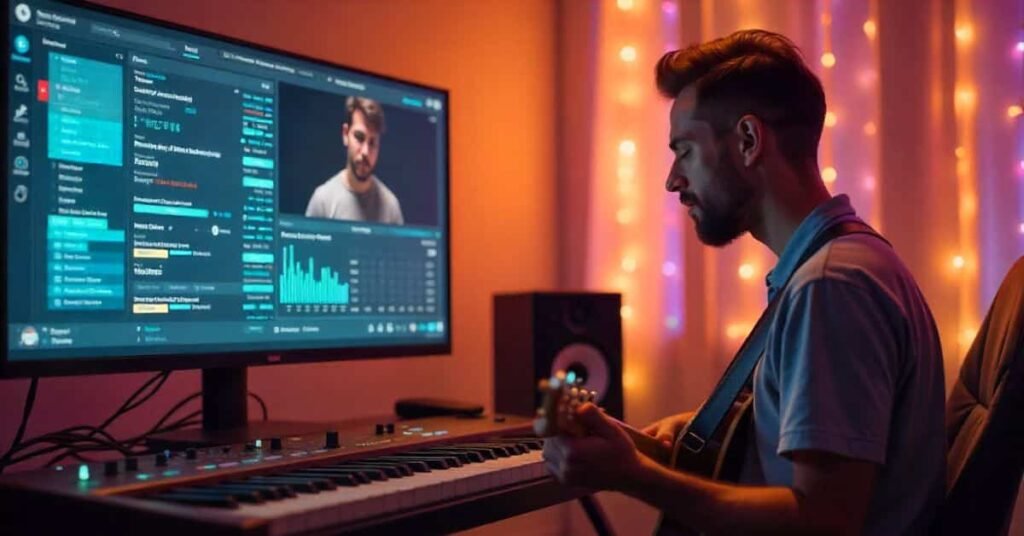
Understanding how AI creates lyrics requires a basic knowledge of machine learning algorithms and language models. These systems are trained on massive datasets containing thousands of songs. From these lyrics, the AI learns patterns in rhyme, rhythm, line structure, and emotional tone.
For example, if an AI is trained on classic rock, it will likely produce lines that echo that genre’s themes and stylistic tendencies. Furthermore, when given a prompt like “dancing in the dark,” the model draws from its training to suggest similar ideas, possibly referencing night, freedom, or longing.
Here’s a quick breakdown of the process:
| Step | Description |
| Data Collection | Thousands of lyrics across genres are collected |
| Pattern Recognition | AI learns rhyme schemes, line lengths, word flow, and emotional markers |
| Prompt Input | The user provides a theme, line, mood, or keyword |
| Lyric Generation | The AI writes new lyrics based on learned language models |
In addition to simple generation, more advanced models like GPT-4 use context-aware prediction. As a result, the lyrics are often coherent, flowing naturally between lines. Still, AI lacks the ability to create from lived experience. That’s where human lyricists maintain an edge.
Benefits of AI Songwriting: Can AI Write Song Lyrics for Artists?
One of the main reasons artists are asking can AI write song lyrics is that it boosts productivity and opens new creative pathways. Let’s explore the top benefits of AI-generated lyrics.
1. Faster Writing Process
First and foremost, AI dramatically speeds up the lyric-writing process. A songwriter who normally spends hours crafting a verse can now generate ideas in seconds.
2. Overcomes Writer’s Block
In addition, AI is incredibly helpful for beating creative blocks. If you’re stuck on a chorus, AI tools can suggest rhyming alternatives or new lyrical directions.
3. Genre Versatility
AI can write in virtually any style, pop, hip-hop, country, EDM, depending on its training data. This flexibility helps both new and seasoned musicians experiment more freely.
4. Accessibility for Beginners
Even people with no songwriting background can now express themselves musically using AI tools. As a result, music creation becomes more democratic and inclusive.
| Benefit | How It Helps |
| Fast Generation | Saves time by quickly producing multiple lyric options |
| Overcomes Writer’s Block | Provides new ideas and directions when creativity is stuck |
| Genre Flexibility | Adapts to various musical styles and tones |
| Increased Accessibility | Allows non-writers to express ideas through lyrics |
While AI doesn’t replace creativity, it certainly enhances it. Therefore, many professionals now use AI as a co-writer or creative assistant during early songwriting phases.
Limitations of AI-Generated Lyrics: What You Should Know

Despite its strengths, AI songwriting tools have significant limitations. While AI can mimic human writing well, it lacks authentic emotion and originality.
1. Lack of Emotional Experience
Although AI understands the words we use to express emotion, it doesn’t feel anything. Therefore, its lyrics can sound hollow or emotionally distant.
2. Tendency to Repeat or Use Clichés
Since AI models rely on large amounts of existing content, they sometimes fall into repetition or generate overused phrases.
3. Cultural and Contextual Blind Spots
AI may misinterpret idioms, slang, or cultural references. For example, a lyric referencing a local tradition might not make sense in AI-generated output.
4. Copyright Concerns
If AI outputs lyrics too similar to its training data, you may risk copyright infringement. Although AI aims to be original, the boundary is sometimes blurred.
| Limitation | Why It Matters |
| No Real Emotion | Limits the depth and impact of the lyrics |
| Repetition and Clichés | Results in generic or unoriginal songwriting |
| Cultural Inaccuracy | Can misrepresent or oversimplify social or emotional themes |
| Copyright Risks | May unintentionally mimic existing songs too closely |
In short, while AI is an impressive tool, human editing is still essential. You should always review and refine AI-generated lyrics before using them professionally.
Human vs AI: Who Writes Better Song Lyrics?
This is one of the hottest debated questions in modern music: can AI ever match the creativity of human songwriters?
Although AI can simulate language and structure, it does not create from experience. Humans write lyrics based on personal stories, heartbreaks, dreams, and hopes. These emotions translate into words that touch hearts.
By contrast, AI predicts what should come next based on data. It doesn’t understand metaphor, irony, or subtext the way a person does. However, it can replicate those devices if they appear often enough in its training.
Let’s compare both approaches:
| Aspect | Human Songwriter | AI Songwriter |
| Creativity | Inspired by life, emotions, and real events | Based on data, patterns, and prediction |
| Emotional Impact | Deep, raw, and uniquely expressed | Imitated from existing emotional language |
| Flexibility | Can innovate, break rules, and experiment | Follows predictable patterns from learned data |
| Purpose | Writes with intent and storytelling | Writes without real intention or emotional context |
However, the best results often come from combining both. Many artists now treat AI as a brainstorming partner. For example, they use it to create a song’s first draft, then tweak it to add personal stories and emotion.
The Future of AI in Songwriting: What Comes Next
As AI tools continue evolving, and as more people ask can AI write song lyrics effectively, they’re becoming more integrated into music production environments. Therefore, it’s important to consider how AI will shape songwriting in the future.
Real-Time AI Co-Writing: Can AI Write Song Lyrics with You?
Soon, AI could assist you live as you write, suggesting better lines, rhymes, and structures while you compose in your DAW.
Hyper-Personalized Music: How AI Writes Song Lyrics for You
AI may help artists write songs that adapt in real-time to a listener’s mood, environment, or listening habits.
Voice-Controlled Songwriting: Can AI Write Song Lyrics?
Imagine writing a song just by speaking ideas aloud, while your AI assistant turns them into rhymed, structured lyrics.
Ethical and Legal Guidelines for AI Writing Song Lyrics
As AI becomes a mainstream tool, new rules around ownership and copyright will emerge to protect creators and prevent misuse.
Predictions:
- Wider use of AI in commercial music
- Collaboration between humans and AI across genres
- Personalized songs for individual listeners
- Built-in AI lyric generators in music production software
In conclusion, the future is collaborative. AI won’t replace songwriters. Instead, it will work alongside them, pushing creativity in new directions.
FAQs:
Q1: Can AI write original song lyrics?
Yes, AI can generate original lyrics based on prompts. However, it lacks emotional understanding, so human editing is often needed.
Q2: Is it safe to use AI-generated lyrics commercially?
Generally, yes. But always check the terms of the AI tool and review lyrics to avoid accidental plagiarism.
Q3: How can AI help me as a songwriter?
AI can give you ideas, rhymes, and song structures quickly. It’s great for beating writer’s block or exploring new genres.
Q4: Do professional artists use AI to write lyrics?
Yes, many musicians and producers use AI tools as creative aids. However, the final lyrics are usually revised by humans.
Q5: Which are the best AI tools for songwriting?
Popular options include ChatGPT, Jarvis (Jasper), Rytr, and Amper Music. These tools offer a mix of lyric generation and melody assistance.
v
Nimra Kanwal is an SEO expert helping businesses grow through strategic content and smart search optimization. She writes for Spectraapex and contributes guest posts to top digital blogs.